
Rethinking Water and Sanitation Systems
Buttler Sweden AB is an innovation company developing engineered systems within water
and sanitation for modern built environments.
About Buttler
Conventional sanitary products are shaped by inherited geometries and established installation traditions, often resulting in compromises between usability, durability and efficiency.
Buttler addresses these constraints by rethinking sanitary systems at a structural level.
Originating from a development initiative launched in 2012 with support from national innovation programs, Buttler develops scalable product platforms based on mechanical precision, hydromechanical control and integrated electronics.
What We Do
Buttler is an industrial product company developing water and sanitary systems for modern buildings.
The company is responsible for product definition, system architecture, industrialization through OEM partners, quality assurance, and market development. Buttler operates with proprietary technology and registered trademarks within its product platforms.
INVERSE
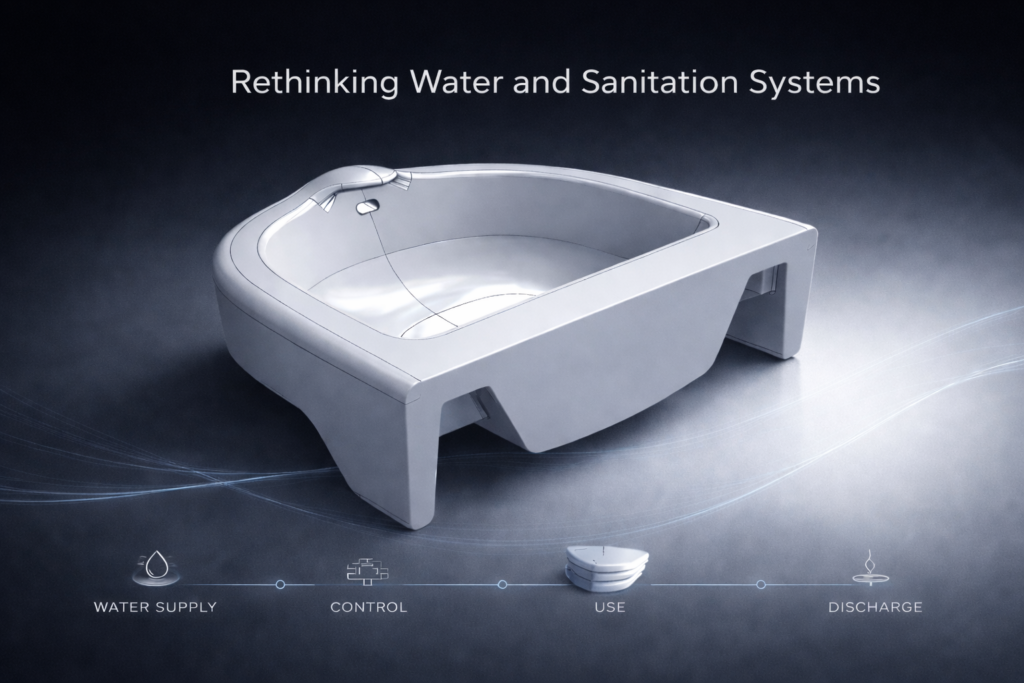
Inverse restructures washbasin geometry by relocating water delivery to the front edge, enabling improved installation height and spatial efficiency without sacrificing usability.
HYDROELECTRONICS
HydroElectronics modularizes hydromechanical control, sensing and safety logic, separating water delivery from mixing and monitoring to enable autonomous operation and improved serviceability.
VORTEX
Vortex explores alternative hydraulic architecture by rethinking flushing energy and reducing reliance on conventional tank systems.
KING
King addresses structural load capacity and dimensional standards, re-evaluating sanitary design for increased user diversity and robustness.
Our Approach
Rather than adapting conventional products, we analyze the sanitary system as a whole, from clean water supply to discharge.
Water delivery, flow control, structural geometry and monitoring are treated as coordinated system functions rather than isolated components.
The objective is structural improvement through clearer system architecture, improved installation logic and more reliable long-term operation across the entire water use cycle.